
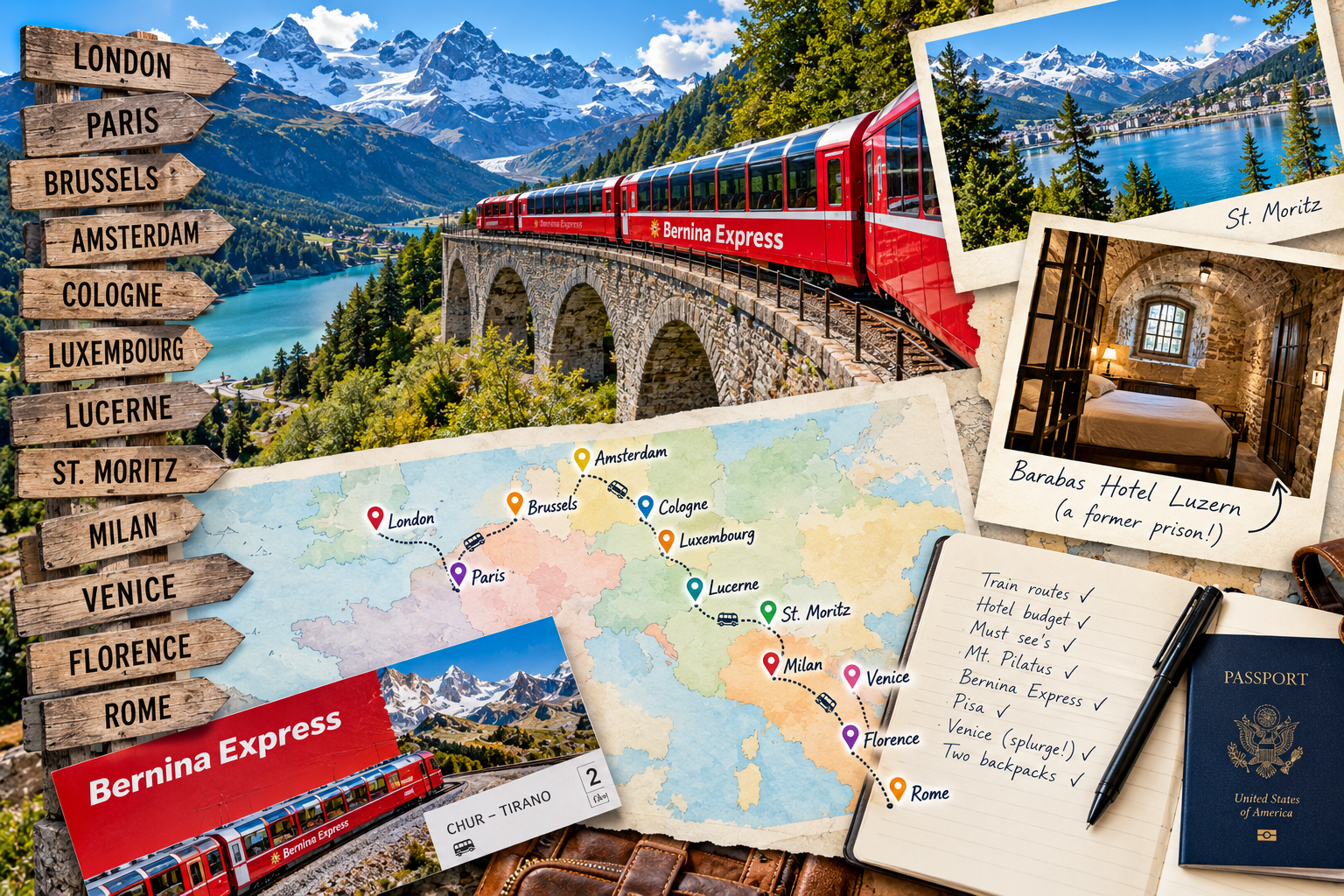
We knew we had 19 days, and Italy was our main event. We also liked the idea of fitting in as many countries as we reasonably could.
So Allie and I sat down and figured out our non-negotiables.
Our top five were pretty easy:
Italy. London. Paris. Switzerland. Amsterdam.
After that came the much harder part:
Deciding which parts of Europe we were willing to leave out.
If you haven’t read my first blog, now’s a good time—because our simple graduation trip to Italy had already gotten a little out of hand.
But Italy was still the reason we were going.
Venice was my number one.
Allie and I both wanted to go to Rome, and she really wanted to see the Leaning Tower of Pisa.
Florence made sense because it gave us an easy way to visit Pisa, and Milan worked because that’s where we’d end up after coming through the Alps from Switzerland.
Italy was taking shape.
Now we just had to figure out everything between London and Italy.
Planning by Train Route…and Hotel Price
London and Paris were obvious.
Amsterdam made the cut because I wanted to add another country I’d never visited.
Then we started looking at train routes.
That’s when Brussels entered the picture.
If we were already traveling through Brussels on our way to Amsterdam, why not stop, explore for the day, spend the night, and continue the next morning?
Then came Germany.
Then Luxembourg.
Clearly, we hadn’t cured ourselves of the:
“Well, if we’re already going to be there…”
problem.
But there actually was some logic behind it.
We wanted to travel primarily by train, so I started looking at the map like a puzzle:
Where is the train already taking us?
Can we stop without going wildly out of our way?
How long will it take to get to the next city?
And perhaps most importantly…
How much is it going to cost us to sleep there?
My $200 Hotel Rule
My goal was to average around $200 per night for hotels.
Some nights would be cheaper and others more expensive, but if I could keep the average around $200, I felt like we could make it work.
Price wasn’t my only consideration, though.
This was just Allie and me—two women traveling alone—so safety and location mattered.
I wanted clean accommodations with good reviews in areas where I’d feel comfortable walking with my daughter, including after dark.
I also didn’t want to spend a fortune getting back and forth from our hotel. I’d much rather walk or use public transportation than rely on taxis or rideshares.
So my hotel criteria became pretty simple:
Safe. Clean. Well-reviewed. Convenient. And preferably around $200.
Turns out that last part was sometimes easier said than done.
Paris—and Mistake Number One
Paris was a perfect example of why location mattered.
We wanted to see the Eiffel Tower sparkle at night, and I didn’t want us navigating the Metro across Paris late at night afterward.
So I found Hôtel Eiffel Kensington, within walking distance of the Eiffel Tower.
Great location.
Reasonable price.
There was just one teeny-tiny detail I failed to triple-check:
Air conditioning.
It didn’t have any.
And naturally, we arrived during a heat wave.
So we learned Mistake Number One very early:
ALWAYS CHECK FOR AIR CONDITIONING.
Fortunately, we’d only booked one night.
Unfortunately, once we got to Paris, I wished we’d booked more. We spent less than 24 hours there.
But that’s a story for Paris Day.
Switzerland: So Many Choices, So Little Time
Switzerland was probably the hardest country to narrow down.
Zurich. Lucerne. Interlaken. St. Moritz. The Alps.
Every time I researched one place, I found three more I wanted to visit.
Originally, Interlaken was on the itinerary, but once I started plugging actual train times into my spreadsheet, I realized we wouldn’t have enough time to enjoy it.
Another lesson:
Just because you can get somewhere doesn’t mean you have enough time to actually experience it.
Then I found a blog post about the Golden Round Trip to Mt. Pilatus from Lucerne.
A boat across Lake Lucerne.
A cogwheel train up the mountain.
Time at the top of Mt. Pilatus.
A cable car back down.
And—most importantly—a summer toboggan run.
Sold.
Lucerne was officially in.
Then I found Barabas Hotel Luzern.
It was reasonably priced, centrally located, and…
It was a former prison.
You can actually sleep in the old prison cells.
Obviously, we had to stay there.
So Lucerne got two nights.
Unfortunately, I apparently hadn’t completely learned my lesson from Paris.
No air conditioning.
In my defense, Switzerland is cold, right?
Who would’ve thought we’d need air conditioning?
Doh.
Those were the two worst nights of sleep of our entire trip.
The former-prison thing was really cool.
Sleeping in a former prison during a European heat wave?
Slightly less cool.
Literally.
But we’ll save that story for Lucerne.
Zurich vs. St. Moritz
At one point, we planned to spend a night in Zurich.
Then I looked at hotel prices.
Nope.
Instead, I found an affordable youth hostel in St. Moritz, and that solved another problem.
We could stay there for two nights, giving us a full day to explore instead of arriving, sleeping, and leaving again immediately.
Plus, St. Moritz put us exactly where we wanted to be for one of the things I’d been obsessing over since the beginning:
The Bernina Express.
We’d travel through the Swiss Alps, cross into Italy at Tirano, and continue on to Milan.
So our four nights in Switzerland were officially set:
2 nights in Lucerne.
2 nights in St. Moritz.
No Interlaken.
No overnight in Zurich.
We couldn’t see everything—and that was okay.
Sometimes you just have to pick the places that fit your route, your time, and your budget and save the rest for another trip.
Our route was set:
Luxembourg → Lucerne → St. Moritz → Bernina Express → Italy.
And Then There Was Venice
Venice was where I broke my own hotel rule.
I originally wanted two nights there.
Then I started looking at hotel prices.
Ouch.
Because we’d never been to Venice, I was especially picky about where we stayed. I wanted somewhere safe, convenient with our backpacks, and easy to find when we arrived.
Eventually, I chose Hotel Antiche Figure, right on the Grand Canal near the train station.
It was easily the nicest hotel of our trip.
It was also easily the most expensive.
So Venice became one night instead of two.
Looking back, I’m glad I splurged for our first visit. Now that I’ve been to Venice and understand how the city works, I’d feel comfortable staying somewhere less expensive next time.
But for our first trip?
Worth it.
Finally, We Had an Itinerary
After what felt like approximately 4,000 versions of the spreadsheet, we finally had it.
Our 19-Day Europe Itinerary
Day 1 — June 17: Fly from California
Day 2 — June 18: Arrive in London
Day 3 — June 19: London
Day 4 — June 20: London → Paris
Day 5 — June 21: Paris → Brussels
Day 6 — June 22: Brussels → Amsterdam
Day 7 — June 23: Amsterdam → Cologne, Germany
Day 8 — June 24: Cologne → Luxembourg
Day 9 — June 25: Luxembourg → Lucerne
Day 10 — June 26: Lucerne
Day 11 — June 27: Lucerne → St. Moritz
Day 12 — June 28: St. Moritz
Day 13 — June 29: St. Moritz → Tirano → Milan
Day 14 — June 30: Milan → Venice
Day 15 — July 1: Venice → Florence
Day 16 — July 2: Florence + Pisa
Day 17 — July 3: Florence → Rome
Day 18 — July 4: Rome
Day 19 — July 5: Fly home
Eight countries. Nineteen days. Two backpacks. And a ridiculous number of trains.
We Had a Plan—Not a Schedule
I had a giant spreadsheet filled with things we could do:
Buckingham Palace. Tower Bridge. The Eiffel Tower. Belgian waffles. Anne Frank House. Cologne Cathedral. Mt. Pilatus. The Bernina Express. The Duomo. Gondolas. Pisa. The Colosseum…
But most weren’t commitments.
A handful of true must-dos were booked in advance. Everything else was an idea.
If we had time, great.
If we were exhausted, we’d skip it.
If we found something better, we’d change the plan.
And I’m really glad we did it that way.
Because there’s planning a trip…
And then there’s actually taking the trip.
Those turned out to be two very different things.
The Plan Was Official
Our little trip to Italy had officially become:
England → France → Belgium → the Netherlands → Germany → Luxembourg → Switzerland → Italy.
The flights were booked.
The hotels were booked.
The train passes were purchased.
The spreadsheet was color-coded within an inch of its life.
There was no turning back now.
Next up: How Two Women Packed for 19 Days in Europe With Just Backpacks
Leave a Reply